

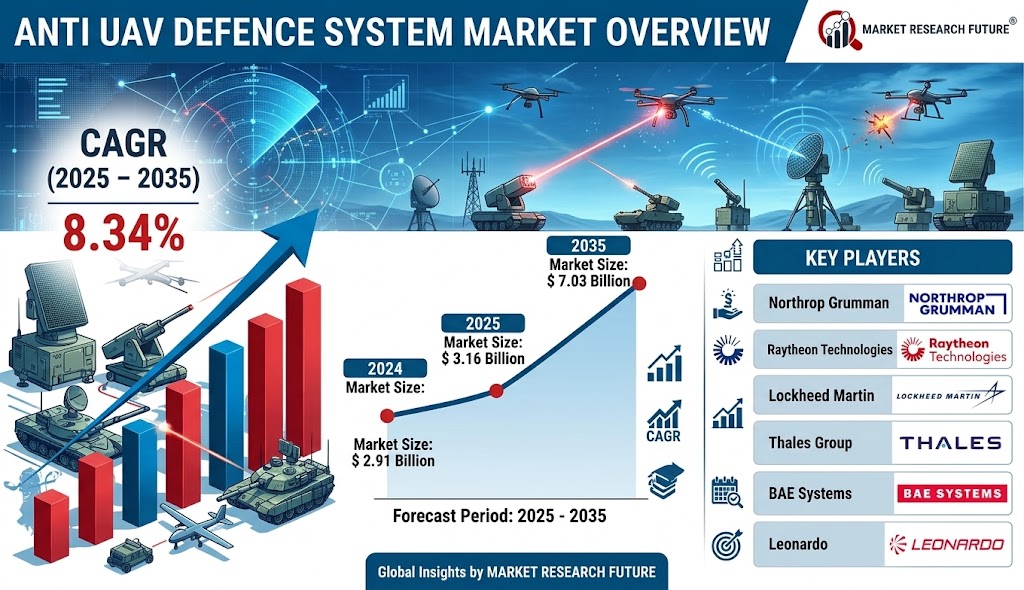
Global Anti UAV Defence System Market Set to Reach US$ 7.03 Billion by 2035, Growing at a CAGR of 8.34%
Anti UAV Defence System Market
Anti UAV Defence System Market expands on rising drone threats, AI-driven detection, and growing defense budgets across military and commercial sectors.
NEW YORK, NY, UNITED STATES, September 2, 2026 /EINPresswire.com/ -- The global Anti UAV Defence System Market is on a firm upward path, with newly compiled industry estimates placing its value at roughly US$ 2.91 billion in 2024 and projecting expansion to nearly US$ 3.16 billion in 2025. Looking further out, the market is expected to approach US$ 7.03 billion by 2035, translating into a compound annual growth rate (CAGR) of about 8.34% across the 2025–2035 forecast window. The trajectory reflects a defense and security landscape reshaped by the rapid proliferation of unmanned aerial vehicles (UAVs) and the corresponding urgency to detect, track, and neutralize unauthorized drone activity across military, government, and commercial settings.A Market Driven by Escalating Drone Threats:
Unmanned aerial systems have moved from a niche military tool to a widely accessible technology used across agriculture, logistics, media, and recreation — and, increasingly, by bad actors seeking to disrupt airports, public events, critical infrastructure, and defense installations. This dual-use reality is the central force propelling the Anti UAV Defence System Market forward. As drones become cheaper, smaller, and more capable, the systems designed to counter them must evolve just as quickly, prompting sustained investment from governments, militaries, and private security operators alike.
Industry observers note that the market's growth is being shaped by a combination of factors: heightened geopolitical tension, a wave of new regulatory mandates governing airspace security, and fast-moving innovation in detection and neutralization technology. Together, these forces are pushing anti-UAV systems from a specialized military niche into a broader, multi-sector security category.
Request for Free Sample of Report: https://www.marketresearchfuture.com/sample_request/35602
Military expenditure remains a particularly influential factor in this shift. As nations prioritize national security and modernize their defense postures, counter-drone technology has become a focal point of procurement strategy. Defense budgets allocated specifically to anti-drone capability are reported to represent a substantial and growing portion of overall military spending, a trend expected to continue as armed forces work to protect personnel, bases, and equipment from low-cost, widely available UAV threats. This dynamic positions the military sector as a durable, long-term catalyst for innovation across the industry, even as commercial and government demand accelerates alongside it.
Technological Advancement at the Core of Growth:
At the heart of this expansion is a wave of technological innovation. Detection and neutralization capabilities are becoming markedly more sophisticated, with radar systems, electro-optical sensors, and radio-frequency jamming tools converging into integrated, multi-layered defense architectures. The incorporation of artificial intelligence and machine learning is further enhancing these systems, enabling faster threat classification, more precise targeting, and reduced reliance on manual operator intervention. This technological momentum is reshaping every corner of the market, from the underlying detection technology through to how systems are deployed and applied across military, government, and commercial settings — dynamics explored in detail below.
Market Segmentations:
The Anti UAV Defence System Market is segmented across four primary categories — Technology, Platform, Application, and System Component — each offering a distinct lens into how the industry is evolving.
By Technology: Laser Systems, Electronic Warfare System, Kinetic Interceptors, Radio Frequency Systems
Laser Systems currently represent the largest technology segment, prized for their precision engagement and their ability to neutralize threats with minimal collateral impact and no reliance on physical projectiles. Their capacity to engage multiple targets in rapid succession, without the logistical burden of replenishing ammunition, has made them an increasingly popular choice among defense forces seeking sustainable, high-tempo response capability.
Electronic Warfare Systems are the fastest-growing technology segment, reflecting rising demand for non-kinetic countermeasures capable of disrupting UAV communications and navigation without destructive engagement — an approach particularly valued in sensitive or populated environments where kinetic engagement carries greater risk.
Kinetic Interceptors, while comparatively early in their development curve relative to laser systems, are gaining traction as a dependable option for neutralizing threats at extended ranges using traditional missile-launch architecture. Radio Frequency Systems continue to serve as a foundational layer within many integrated defense networks, providing early warning and signal disruption capabilities that complement the more targeted engagement offered by lasers and interceptors. Taken together, these four categories illustrate a market that is diversifying rather than consolidating around a single approach, with layered, multi-technology defense architectures increasingly viewed as the most resilient path forward.
By Platform: Ground, Naval, Airborne
The Ground platform currently dominates the market, benefiting from established military infrastructure and proven reliability across both fixed installations and mobile deployments. Ground-based systems continue to serve as the backbone of counter-drone operations in conflict zones and at fixed, high-value sites.
Airborne platforms represent the fastest-growing category, gaining momentum as advances in onboard sensor integration and agile response capability make aerial counter-drone assets increasingly attractive for real-time, mobile threat engagement.
Naval platforms round out the segment, playing a vital, if comparatively smaller, role in protecting maritime assets, fleets, and coastal installations from aerial incursion — a role expected to grow as naval forces increasingly encounter UAV-based surveillance and attack threats at sea.
By Application: Military, Commercial, Government
Military applications remain the anchor of the market, reflecting sustained defense budgets and the strategic priority placed on protecting personnel, bases, and equipment from UAV-borne threats.
The Commercial segment is expanding at the fastest pace, as industries such as logistics, agriculture, energy, and event management recognize their exposure to rogue drone activity and begin adopting protective measures once reserved almost exclusively for defense applications.
Government applications — spanning border security, critical infrastructure protection, and public-safety operations — continue to grow in parallel, reinforced by expanding regulatory requirements that increasingly mandate counter-drone coverage at airports, government facilities, and other sensitive public sites.
By System Component: Sensors, Command and Control, Effectors
Sensors account for the largest share of market value among system components, underscoring their foundational role in early threat detection and situational awareness. Radar, electro-optical, and radio-frequency sensing technologies together form the front line of any effective counter-drone architecture.
Effectors — the systems responsible for physically or electronically neutralizing a threat once identified — represent the fastest-growing component category, benefiting from continued advances in both lethal and non-lethal response technology; industry estimates suggest this segment could roughly double in value over the coming decade as neutralization capabilities mature.
Command and Control systems, while comparatively smaller in scale, play a dominantly strategic role, enabling seamless coordination among detection and response mechanisms. Increasingly equipped with advanced decision-support algorithms, these systems serve as the connective layer that ties sensors and effectors into a coherent, real-time operational system.
Regional Outlook:
"North America Leads, Asia-Pacific Accelerates"
Regionally, North America continues to command the largest share of the global Anti UAV Defence System Market, commanding an estimated two-fifths or more of global revenue. The region's leadership is underpinned by substantial defense expenditure, an advanced regulatory environment overseen by aviation and security authorities, and a concentration of major defense contractors headquartered in the United States. Canada contributes additional momentum through its own counter-drone initiatives and close collaboration with U.S. defense programs.
Europe holds the position of a strong secondary market, accounting for roughly a third of global share. Growth across the region is being driven by coordinated defense initiatives among EU member states, evolving airspace-security regulation, and a sustained push to strengthen border and public-safety protections. France, the United Kingdom, and Germany are the region's leading contributors, home to some of the sector's most active defense technology developers.
Asia-Pacific stands out as the fastest-growing regional market, currently estimated at around one-fifth of global share but expanding quickly as nations across the region increase military expenditure and modernize national security infrastructure. China leads the region with heavy investment in indigenous defense technology, while India is rapidly scaling its own counter-drone capabilities as part of broader military modernization efforts. The Middle East and Africa region, while comparatively smaller at roughly five percent of the global market, is seeing meaningful growth as countries such as the United Arab Emirates and Saudi Arabia invest in advanced defense systems amid heightened regional security concerns.
Competitive Landscape:
"Established Defense Leaders Drive Innovation"
The competitive environment surrounding the Anti UAV Defence System Market is best described as moderately fragmented, with a core group of established defense contractors exerting significant influence while leaving room for specialized and regional players to carve out niches. Leading companies shaping the market include Northrop Grumman, Raytheon Technologies, Lockheed Martin, Thales Group, BAE Systems, Leonardo, Israel Aerospace Industries, Elbit Systems, Saab, and General Dynamics.
Northrop Grumman continues to focus on advancing detection and neutralization technology, while Raytheon Technologies has placed particular emphasis on embedding artificial intelligence into its systems to sharpen operational efficiency. Israel Aerospace Industries has been actively expanding its international footprint, forging strategic collaborations across Europe and Asia that broaden its competitive reach. Lockheed Martin and Thales Group remain central to the market's innovation pipeline, with both companies pursuing next-generation solutions — Lockheed Martin through a partnership aimed at applying machine learning to real-time threat assessment, and Thales Group through the development of urban-focused systems that combine advanced radar with electro-optical sensing to address the unique challenges of drone threats in dense city environments.
Elsewhere in the competitive field, Israel Aerospace Industries has secured new contracts extending its anti-drone systems into European markets, reflecting the broader trend of established players seeking global expansion to capture emerging demand. Additional activity from companies such as DroneShield, General Dynamics, BAE Systems, Leonardo, and UTC Aerospace Systems points to a market where research and development investment, strategic partnerships, and joint ventures are increasingly central to maintaining a competitive edge. Leonardo and Thales Group, in particular, have been engaging in joint ventures aimed at pooling technical resources and expertise, allowing both companies to deliver more comprehensive, end-to-end solutions in an increasingly crowded field. Rather than competing primarily on price, industry participants are shifting toward differentiation built on technological sophistication, integration capability, and supply chain reliability.
Looking across the sector as a whole, competitive trends are increasingly defined by digitalization, sustainability considerations, and the deeper integration of artificial intelligence into core product lines. Strategic alliances are becoming more common as companies recognize that pooling resources and technical expertise is often a faster path to market relevance than pursuing every capability independently. This trend is expected to accelerate in the years ahead, with mid-sized and niche players playing an increasingly important role alongside the sector's largest defense contractors, even as the latter continue to set the pace on large-scale program wins and government contracts.
Regulatory Momentum and Market Opportunity:
A significant share of the market's growth potential is tied to the tightening regulatory environment surrounding drone operations. Governments worldwide are introducing more stringent airspace-management policies, often mandating the deployment of counter-drone systems at airports, military installations, and other sensitive sites. This regulatory push is expected to remain one of the most consistent demand drivers for the industry, compelling both public agencies and private operators to invest in compliant, next-generation solutions.
Looking ahead to 2035, the Anti UAV Defence System Market is expected to solidify its role as a core pillar of global security infrastructure. Emerging opportunities include the development of fully integrated detection-and-neutralization platforms, expansion into developing markets with solutions tailored to local threat profiles, and deeper partnerships between technology developers and defense contractors to accelerate research and development. As artificial intelligence, sensor fusion, and electronic warfare capabilities continue to mature, industry stakeholders anticipate a steady shift toward smarter, more adaptive systems capable of responding to an increasingly complex UAV threat landscape.
Stakeholder Implications:
For defense procurement officers, the practical takeaway is that layered, multi-technology defense architectures are increasingly outperforming single-technology deployments, particularly in environments where threat profiles vary by altitude, range, and payload. For commercial operators — particularly in logistics, energy, and event management — the message is that counter-drone investment is shifting from a discretionary security expense to an operational necessity, driven both by regulatory pressure and by the tangible cost of drone-related disruption. For investors and technology developers, the data point to sustained opportunity in sensor fusion, AI-enabled threat classification, and effector technologies capable of scaling from small tactical deployments to large, integrated national defense networks.
Market Research Future
Market Research Future
+ +1 855-661-4441
sales@marketresearchfuture.com
Legal Disclaimer:
EIN Presswire provides this news content "as is" without warranty of any kind. We do not accept any responsibility or liability for the accuracy, content, images, videos, licenses, completeness, legality, or reliability of the information contained in this article. If you have any complaints or copyright issues related to this article, kindly contact the author above.
